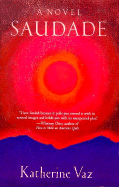
 What a wonderful way to end my first official 999 challenge! The last book in my “Things Portuguese” category. I inherited this book from my husband’s aunt who lived in a Portuguese community in the central valley of California before moving to the Bay area. It’s an incredible work, and almost defies a good review because reading it is a visceral rather than cerebral experience. Just like “saudade".
The Author opens the book thus:
What a wonderful way to end my first official 999 challenge! The last book in my “Things Portuguese” category. I inherited this book from my husband’s aunt who lived in a Portuguese community in the central valley of California before moving to the Bay area. It’s an incredible work, and almost defies a good review because reading it is a visceral rather than cerebral experience. Just like “saudade".
The Author opens the book thus:
Katherine Vaz is a verbal artist. This story of saudade is not easy to read, but the word painting of this experience is so profound that one finishes the book with the same deep sigh of plentitude that causes us to push back from a nine-course meal, pat our stomachs and say “I’m full.” Full is definitely what the reader is reading this story. The words, the colors, the people, the experiences that are splashed across the pages, and burned into the psyche have one gasping at times. This prose is the closest to poetry one can get without it being poetry. It's positively magical. The main character Clara Cruz is born in the Azores and at birth and in early childhood does not seem capable of speech. The reader is left to puzzle out whether the inability to verbalize is physical or something akin to autism. Vaz constructs a cast of village mentors, including her parents, who help young Clara learn to communicate. At first this ‘talk’ is done with sugar, grains of it constructed into figures, drawn in lines on tables (much like drawing in sand?). Later some sign language is woven in. The songs her parents croon to her, making sure she can feel the vibrations of sound, become woven with their insistence that she be exposed to as much color, sound, light, and touch as is possible. These are not child psychologists or speech therapists; these are simple peasants living out their lives in a village full of every sensory experience known, with centuries of tradition, folk tales, and superstition to enhance their stories. They make sure their child's journey through life is as full of experience as possible. When her mother inherits a vineyard in California, Clara’s parents plan to move there. Her father, a fisherman from birth, is somewhat reluctant to leave the only way of life he has ever known, but he finally promises to make just one last voyage and then they will go. Unfortunately, it is his last voyage, and the ‘saudade’ that overcomes her mother eventually leads to her dying from longing. It is difficult to review this book without spoilers, but I’m going to try to avoid telling too much of what happens after this. Clara does go to California, where she is raised by other members of the Portuguese community in Lodi, and where she has to deal with a double-dealing priest who tries to cheat her out of her inheritance. In plotting her revenge against him, she discovers inner strengths, and new ways of coping, but also endures unbearable tradgedy, adding to her saudade. She enrolls in the local schools in Lodi, and becomes more communicative, but her extreme sensitivity to touch, colors, and others’ perceptions is the basis for an incredible sensual journey from adolescence to adulthood. She meets Dr. Helio Soares, the local dentist, who eventually becomes her lover, and who is someone who is as sensually acute and astute as she is. Vaz’ ability to weave word pictures, to relate folk tales from both the Azorean and California Portuguese communities, and her intense use of imagery is the basis for an incredible portrait of a young woman’s coming of age, and eventual accommodation to adulthood. At times, the fantasies approach Alice’s slide down the rabbit hole, but all are finally believable. The introduction throughout of heteronyms (not the grammatical words that are spelled alike with different meanings, but the literary device of imaginary characters created by a poet, or dreamer) was a new experience for me. I had to stop and look up how the word was intended, but once understood, as the latter, it provides incredible depth to the characters. At one point, Helio is shown different heteronyms for Clara in his saudade. One is an 18 year old cook’s assistant named Xica, living in sixteenth century Sintra Portugal. As Xica bastes roasting meat, she chants this poem:Saudade ('Sow-Dahd’) A Portuguese word considered untranslatable. One definition: Yearning so intense for those who are missing, or for vanished times or places, that their absence is the most profound presence in one’s life. A state of being, rather than merely a sentiment.
Wall-splashing ping of unction extreme
Ooze of sardine, halibut, bream.
Blubber-fried roe, peppers well oiled,
Jelly from hoofs, eel’s gut uncoiled.
Bacon-From-Heaven—an almond cake---
Sausage with kid roast, lard-basted hake….
Xica further states “love renders us a banquet of drippings, salves, saturates, banquet of creams. I once loved a dear man fatly.”
At one point, Vaz states that the characters: “Together with the starfish, they would live in a bastion that is defined by cleave—a grand but unsettling word that is at once its own opposition:
To pierce, sever, divide by a blow.
To cling, adhere, ever to hold fast.
This kind of mind-blowing prose puts this work on the edge of fantasy, and one can’t help but wonder how much her Portuguese heritage influenced all this imagery. It is a feast for the reading mind from a writer who deserves more attention.


 Posts
Posts


