Showing posts with label award winner. Show all posts

Monday, September 7, 2009

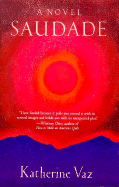
Review: Saudade by Katherine Vaz

What a wonderful way to end my first official 999 challenge! The last book in my “Things Portuguese” category. I inherited this book from my husband’s aunt who lived in a Portuguese community in the central valley of California before moving to the Bay area. It’s an incredible work, and almost defies a good review because reading it is a visceral rather than cerebral experience. Just like “saudade". The Author opens the book thus:
Saudade ('Sow-Dahd’) A Portuguese word considered untranslatable. One definition: Yearning so intense for those who are missing, or for vanished times or places, that their absence is the most profound presence in one’s life. A state of being, rather than merely a sentiment.
Katherine Vaz is a verbal artist. This story of saudade is not easy to read, but the word painting of this experience is so profound that one finishes the book with the same deep sigh of plentitude that causes us to push back from a nine-course meal, pat our stomachs and say “I’m full.” Full is definitely what the reader is reading this story. The words, the colors, the people, the experiences that are splashed across the pages, and burned into the psyche have one gasping at times. This prose is the closest to poetry one can get without it being poetry. It's positively magical. The main character Clara Cruz is born in the Azores and at birth and in early childhood does not seem capable of speech. The reader is left to puzzle out whether the inability to verbalize is physical or something akin to autism. Vaz constructs a cast of village mentors, including her parents, who help young Clara learn to communicate. At first this ‘talk’ is done with sugar, grains of it constructed into figures, drawn in lines on tables (much like drawing in sand?). Later some sign language is woven in. The songs her parents croon to her, making sure she can feel the vibrations of sound, become woven with their insistence that she be exposed to as much color, sound, light, and touch as is possible. These are not child psychologists or speech therapists; these are simple peasants living out their lives in a village full of every sensory experience known, with centuries of tradition, folk tales, and superstition to enhance their stories. They make sure their child's journey through life is as full of experience as possible. When her mother inherits a vineyard in California, Clara’s parents plan to move there. Her father, a fisherman from birth, is somewhat reluctant to leave the only way of life he has ever known, but he finally promises to make just one last voyage and then they will go. Unfortunately, it is his last voyage, and the ‘saudade’ that overcomes her mother eventually leads to her dying from longing. It is difficult to review this book without spoilers, but I’m going to try to avoid telling too much of what happens after this. Clara does go to California, where she is raised by other members of the Portuguese community in Lodi, and where she has to deal with a double-dealing priest who tries to cheat her out of her inheritance. In plotting her revenge against him, she discovers inner strengths, and new ways of coping, but also endures unbearable tradgedy, adding to her saudade. She enrolls in the local schools in Lodi, and becomes more communicative, but her extreme sensitivity to touch, colors, and others’ perceptions is the basis for an incredible sensual journey from adolescence to adulthood. She meets Dr. Helio Soares, the local dentist, who eventually becomes her lover, and who is someone who is as sensually acute and astute as she is. Vaz’ ability to weave word pictures, to relate folk tales from both the Azorean and California Portuguese communities, and her intense use of imagery is the basis for an incredible portrait of a young woman’s coming of age, and eventual accommodation to adulthood. At times, the fantasies approach Alice’s slide down the rabbit hole, but all are finally believable. The introduction throughout of heteronyms (not the grammatical words that are spelled alike with different meanings, but the literary device of imaginary characters created by a poet, or dreamer) was a new experience for me. I had to stop and look up how the word was intended, but once understood, as the latter, it provides incredible depth to the characters. At one point, Helio is shown different heteronyms for Clara in his saudade. One is an 18 year old cook’s assistant named Xica, living in sixteenth century Sintra Portugal. As Xica bastes roasting meat, she chants this poem:
Wall-splashing ping of unction extreme Ooze of sardine, halibut, bream. Blubber-fried roe, peppers well oiled, Jelly from hoofs, eel’s gut uncoiled. Bacon-From-Heaven—an almond cake---
Sausage with kid roast, lard-basted hake….
Xica further states “love renders us a banquet of drippings, salves, saturates, banquet of creams. I once loved a dear man fatly.” At one point, Vaz states that the characters: “Together with the starfish, they would live in a bastion that is defined by cleave—a grand but unsettling word that is at once its own opposition:
To pierce, sever, divide by a blow. To cling, adhere, ever to hold fast.
This kind of mind-blowing prose puts this work on the edge of fantasy, and one can’t help but wonder how much her Portuguese heritage influenced all this imagery. It is a feast for the reading mind from a writer who deserves more attention.

Monday, July 13, 2009

Review: Little Fingers

This is one of the most confusing books I've ever read. It is also one of the best. My head is still spinning from the extraordinarily long paragraphs (some as long as 10 pages) and I think I understand "what happened' in the end. The story is about a town in Rumania where a mass grave of bodies is discovered. Various personalities have theories about the who, when, and why of all these bodies, but it isn't until a team of Argentinian soccer players who happen to be forensic archaeologists shows up (and they are an entire sub-story) that the story seems to resolve itself. The characters--their stories and conversations--are the strength of the book. I felt at times that Robin Williams had invaded James Joyce's brain...the stream of conscious, free wheeling, long, long sentences with lots of paragraphs, left me breathless. There is the young anthropologist Petrus, his slightly nutty Auntie Paulina, her daughter Jo-Jo (she whose anatomy always brought to his mind various ripe fruits); there's the Orthodox monk with the hair that had to be trimmed every 8 hours and the visions of the Holy Mother telling him what to do, who transcribes the Bible on birch bark, and hears confession via hidden letters left in a rose bush; there's the police chief with the missing little finger,and the photographer with his camel Alladin; the list goes on. There is no way to describe the plot. The book is a free fall of ideas about the mystery of the mass grave. It's an easy read if you sit down and stay with it, but it is also a hard read. One well worth undertaking. Last note: The translator Alistair Ian Blyth did a masterful job. The book was named the Best Debut Novel of the Romanian Writers Union, 2006, the Best First Novel of Romania literara, 2005, and won the Best Debut Novel Award of the National Union of the Romanian Employers, 2005.

Wednesday, June 3, 2009

Review: Mistress of the Art of Death

This book is the Summer 2009 Highly Rated Book Group online discussion over on LT. I can't believe I missed it when it first came out in 2007. This is going to be one of my top 5 of the year. It is so good, that I galloped ahead and stayed up 1/2 the night to finish listening to the audio, which is masterfully done by Rosalyn Landor. I could hear the medieval street noise, smell the river, and see the mists. If you like historical fiction, forensic pathology suspense thrillers, medieval pageantry, romance, and intricate plots, this is the book for you. The characters are unforgettable and the story is many layered:
  1. Young children are disappearing from the town of Cambridge, and turning up later as skeletons showing evidence of unspeakable torture and death.
  2. In England at that time, money lending was illegal. Only Jews were allowed to lend money, so they were tolerated. However the Jews were accused of killing the children.
  3. Henry II, needing the Jews to keep his country solvent (no bishop could build a cathedral, no knight embark on a Crusade without borrowing) orders the entire Jewish population of the town into sanctuary within the castle walls. Still the killings continue.
  4. At this same time, the town of Salerno in Italy is turning out trained forensic scientists and doctors. Henry sends to his friend the King of Sicily for a "Doctor of Death" to solve the mystery of who is killing the children.
  5. Sicily sends its most noted Doctor of Death,Vesuvia Adelia Rachel Ortese Aguilar, perhaps not realizing that in England, women who 'practice medicine' are more often seen as witches. Adelia is accompanied by Simon the Jew of Naples, and Mansur, a Saracen eunoch who acts as a bodyguard....a sort of medieval CSI team.
Those are just a few of the layers. Add in a Prior with a bad prostrate, an Abbess with a lousy attitude and even worse abbey management skills, an adorable child right out of Dickens, some rather rude and nasty knights, a delightful eelmonger/housekeeper and her helpers Mathilde A and Mathilde B, and you have the beginnings of a wonderful bubbling cauldron of a story. And let's not forget the dog named Safeguard....her description is so great, I can almost smell him myself. All the ingredients blend into an absolute page-turner. Just when you think it's solved, something else twists and you're off on another rollercoaster of emotion, and terror. In spite of the horror of the subject, Franklin manages to inject spots of humor that leave you chuckling with glee. The scene where she catherizes the poor Prior is worth the price of the book. The humanity and compassion displayed by all members of the team bode well for future books in the series. These are people you want to get to know. This is a woman you can root for. This is the first of what is promised to be a series about this wonderful female forensic pathologist. I've already ordered the next in the series: The Serpent's Tale.

Sunday, May 31, 2009

Review: Our Lady of the Artichokes....

When I first saw the title, I laughed out loud and ordered it. I think I expected something on the line of 'Dave Barry poking fun at the Japanese' humor. HOWEVER....this is a serious, well-written, at times very deep, collection of stories that could only have been written by a Luso(Portuguese)-American. I'm married to one. We have many relatives in California's central valley where several of the stories are set. This morning as we ate breakfast, my husband related his memories of the Holy Ghost Festivals (today being Pentecost) and we discussed the story The Man who was made of Netting. Manny wanted his daughter to be the star of the festival and so found some creative financing to get her a gem studded cape (at a mere $10K!) to wear in the procession. The results of this desire/decision are in that category of 'would be comical if it weren't so sad.' The story of the young Portuguese girl writing to Sr. Lucia (the last survivor of the Fatima miracle and the keeper of the 'last secret') is one every woman who ever had a dream as a pre-teen can relate to. Written as a series of letters, it shows the progression of dreams being dashed by reality. The title story, Our Lady of the Artichokes --so California in addition to being so Portuguese--I won't do spoilers-- is again funny and sad. All the stories have a desolate beauty, a longing for a better life while being resigned to what is here and now. A Portuguese saudade if you will. The prose is so sharp it can cut. For example:
Women were leaning over windowsills, looking altogether like open flaps in an Advent Calendar.
I didn't like the first story Taking a Stitch in a Dead Man's Arm and put the book down over a month ago, but came back to it and found on a re-read that while I may not like it, I can feel it, and appreciate the prose. The final story, The Lisbon Story -- about two dying men--one young, one old-- who are brought together by a house in Lisbon is a stunner, and will cause me to come back periodically to pick up this book and read a story here and there again and again.
I suspected it was five in the morning, an hour I worship; the sky pounds the black pearl of the night until it is in pieces and for a brief time, right then, the white of day is the grout holding it together, a perfect tiled mosaic to greet us...
This is definitely a sleeper. If you live in California, or have any Portuguese relatives or friends, you'll really enjoy this wonderful collection by Katherine Vaz.

Tuesday, April 28, 2009

Review: The Miraculous Journey of Edward Tulane

It's that time of year when I get ready for the annual granddaughter summer visit. Now that she's 8 1/2 and reading very well on her own thank you, I've been searching through the stacks at the library (and in our library) for suitable volumes for "her" shelf in the guest room. At the same time, I needed to add some titles to my "Award Winners" category on the LT 999 Challenge. This filled both requirements. Such a beautiful story, in a beautiful book full of gorgeous and gentle illustrations. I can't wait to give this to my grand-daughter. I'll have to get her one of her own because I know she won't want to part with this one to send it back to the library. The story is of a rabbit who learns to love and let himself be loved as he goes through a series of (mis)adventures, disasters, different names (and genders) and belonging to various people. It is a story absolutely bound to steal children's and adult's hearts. It can be read aloud to younger children, and then cherished by older ones. No wonder it won so many awards! It is a timeless chldren's classic that would be a welcome addition to any bookshelf.